
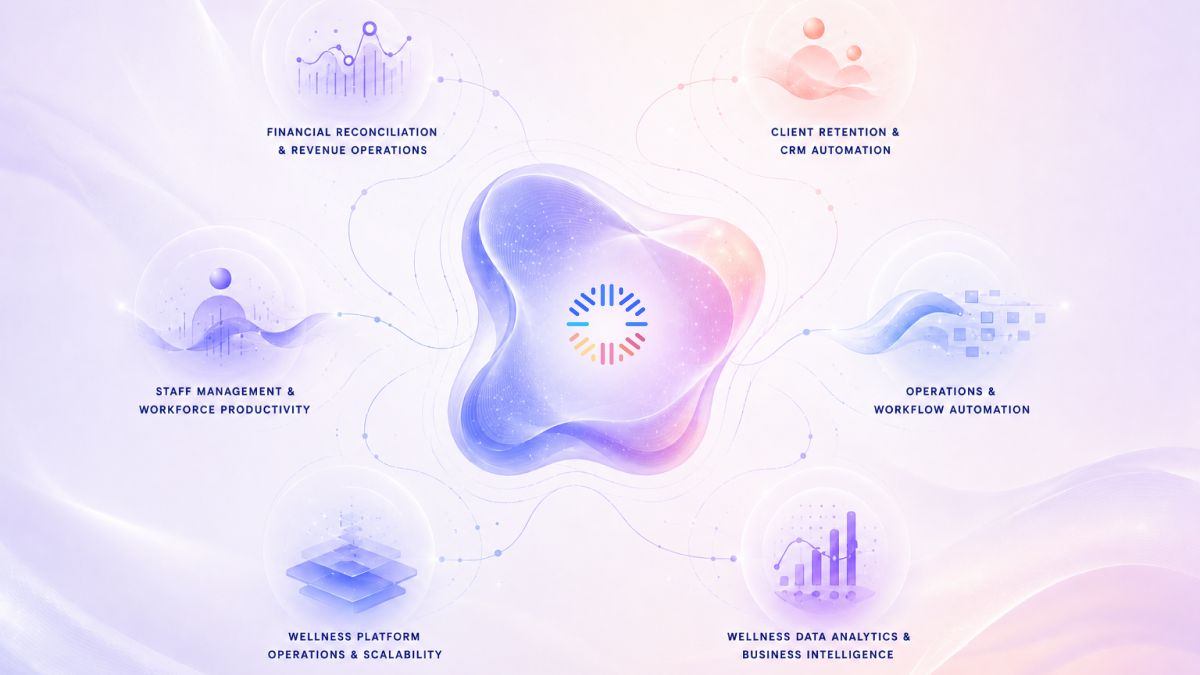
TL;DR
Wellness businesses using artificial intelligence are cutting operational costs 30%, recovering 20% of lost revenue, and scaling without hiring. Here are 6 proven B2B use cases.

Your gym just lost another 40 members this quarter. Your finance team spent three days reconciling last month's billing discrepancies. Your operations manager is juggling vendor invoices, staff schedules, and facility maintenance across five locations. And your front desk team spends more time answering “what are your hours?” than actually signing up new members.
The wellness industry hit $6.8 trillion globally (Source: Global Wellness Institute), but most wellness businesses are stuck running on spreadsheets, gut feelings, and underpaid staff doing five jobs at once. The corporate wellness market alone will reach $100 billion by 2026 (Source: Speakwise), and employers aren't spending that money on gym passes nobody uses. They want data-driven results, health outcomes they can measure, and wellness technology that actually moves the needle.
The AI in fitness and wellness market is valued at USD 10.68 billion in 2025 and is predicted to reach USD 57.80 billion by 2035 at a 19.3% CAGR (Source: InsightAce Analytic). This isn't a trend. It's a structural shift in how wellness businesses operate.
Here's the critical distinction: Artificial intelligence in the wellness industry doesn't touch clinical intelligence. Diet plans, treatment protocols, mental health assessments, and therapeutic interventions stay firmly in the hands of qualified professionals. What AI does is automate the operational layer that consumes 60-70% of wellness business staff time: billing, scheduling, vendor management, CRM, and business intelligence.
Odin AI is HIPAA certified, which means it handles sensitive health data within regulated guardrails while focusing exclusively on operational automation, not clinical decision-making.
This article covers six proven business use cases in health and wellness with real numbers and implementation playbooks you can use this quarter.
The Business Case: Why Wellness Companies Can't Ignore Artificial Intelligence
The numbers paint a clear picture:
- $6 for every $1: ROI from comprehensive wellness programs (Source: Yuna Workplace Wellness Statistics 2026)
- 91% of organizations say wellness programs improve employee productivity (Source: Wellhub Return on Wellbeing 2026)
- 91% of small-to-medium-sized healthcare companies will either expand or implement AI in 2026 (Source: Chase Report for Business)
- 25-30% drop in absenteeism after implementing AI-powered wellness programs (Source: Holisticare)
- 32% savings on healthcare costs for companies with structured wellness programs (Source: Sperity Health)
- 25% lower employee turnover in companies with wellness initiatives (Source: Infeedo)
The catch? These returns only materialize when wellness programs are measured, managed, and continuously optimized. The operational overhead of running a wellness business, from financial reconciliation to vendor coordination, eats the margin that should fund growth. Data-driven artificial intelligence gives that margin back.
“95% of companies that actively measure wellness ROI see positive returns. The problem isn't whether wellness programs work. It's whether your business has the operational infrastructure to deliver them at scale.”
— Source: Speakwise Employee Wellness Statistics 2026

Use Case 1: Financial Reconciliation and Revenue Operations
Money leaks out of wellness businesses quietly. Failed payment processing, missed billing cycles, inconsistent pricing across locations, and manual expense tracking create a revenue gap that compounds month over month. AI closes that gap.
The Problem
A wellness chain with 15 locations processes thousands of transactions monthly: memberships, class packs, personal training packages, retail sales, and corporate contracts. Each payment channel has its own reconciliation process. Staff spend 10-15 hours per week matching invoices to bank statements, chasing failed payments, and reconciling across systems. The error rate on manual reconciliation runs 3-5% (Source: BlackLine Finance Automation), which on $2 million in monthly revenue means $60,000-100,000 in unrecovered or misallocated funds annually.
How AI Fixes It
- Automated payment matching: AI reconciles transactions across Stripe, bank feeds, POS systems, and member management platforms in real time, flagging discrepancies instantly instead of at month-end
- Failed payment recovery: AI detects failed recurring payments within hours, not weeks, and initiates automated recovery sequences with personalized messaging to the member
- Expense categorization: AI reads vendor invoices, categorizes expenses by location and department, and matches them to budget lines without manual data entry
- Revenue leakage detection: AI identifies pricing discrepancies, unapplied discounts, and billing errors across locations, recovering revenue that would otherwise go unnoticed
- Financial reporting automation: Instead of staff spending days compiling monthly P&L reports, AI generates real-time dashboards showing revenue by location, member segment, and service line
The Numbers
| Metric | Manual Reconciliation | AI-Powered Revenue Ops |
|---|---|---|
| Time spent on reconciliation | 10-15 hours/week | 1-2 hours/week |
| Revenue leakage rate | 3-5% | Under 0.5% |
| Failed payment recovery | 40-60% | 85-95% |
| Month-end close time | 7-10 days | 1-2 days |
Who's Doing It
BlackLine provides AI-powered financial close automation used by wellness enterprises to eliminate manual reconciliation (Source: BlackLine Finance Automation Report). Zuora and Chargebee offer AI subscription billing platforms that handle recurring membership payments, failed payment retries, and revenue recognition for subscription-based wellness businesses. Pilot and Zeni provide AI bookkeeping that automates expense categorization and financial reporting for multi-location operations.
Use Case 2: Client Retention and CRM Automation
Gyms, studios, spas, and wellness centers lose 30-50% of their members annually. The acquisition cost for a new gym member is 5-10x the cost of retaining an existing one. AI flips the math.
The Problem
Wellness businesses run on thin margins. Front desk staff juggle bookings, member inquiries, retention calls, and marketing. They can't personalize outreach to 500 members. So everyone gets the same email blast: “Come back! We miss you!” It doesn't work.
How AI Fixes It
- Churn prediction: AI uses predictive analytics to analyze attendance patterns, booking frequency, payment history, and employee engagement signals to identify members at risk of leaving 30-60 days before they cancel
- Personalized re-engagement: Instead of mass emails, AI triggers individualized outreach: a text from a trainer they like, a class recommendation based on their history, a special offer calibrated to their price sensitivity. Machine learning algorithms improve these recommendations with every interaction
- AI front desk: AI handles inbound calls, emails, and chat 24/7, booking trial classes, answering questions, and following up with leads. Gold's Gym DC Metro saw 10x lead growth across 20 locations using AI front desk (Source: Replify)
- Win-back automation: AI identifies lapsed clients and runs personalized win-back sequences based on why they left, not just that they left
The Numbers
| Metric | Manual CRM | AI-Powered CRM |
|---|---|---|
| Member churn rate | 40-50% annually | 20-30% annually |
| Lead response time | 4-24 hours | Under 2 minutes |
| Re-engagement rate (lapsed members) | 5-10% | 25-35% |
| Front desk staff time on admin | 70% | 30% |
Who's Doing It
Gleantap provides AI-powered CRM for gyms that personalizes member engagement at scale. WellnessLiving launched the industry's first AI-powered all-in-one marketing platform with win-back automations for gyms, yoga studios, med spas, and salons (Source: Newswire, April 2026). Adminify AI offers AI employees specifically for fitness and wellness businesses that handle inquiries, book trial classes, and follow up with prospects 24/7.

Use Case 3: Staff Management and Workforce Productivity
Wellness businesses have some of the highest staff turnover in any industry. A gym might onboard 10-15 new trainers or front desk staff per quarter. Scheduling is a puzzle with 50 pieces: trainer availability, client preferences, class capacity, equipment access, labor law compliance, and last-minute call-outs. AI handles the operational side so managers can focus on building teams, not filling timesheets.
The Problem
Most wellness managers spend 5-10 hours per week on scheduling alone. Staff onboarding takes 2-4 weeks before a new hire is productive. Performance tracking is subjective and inconsistent across locations. The result: overstaffed during slow periods, understaffed during peaks, inconsistent training quality, and high turnover because staff feel unsupported.
How AI Fixes It
- Demand-based scheduling: AI uses predictive analytics to forecast class attendance and client traffic patterns, then optimizes staffing levels to match demand. No more overstaffed Tuesday mornings and understaffed Saturday afternoons
- Automated shift management: When a trainer calls out sick, AI redistributes their classes to available staff and notifies affected clients with rebooking options in under 60 seconds
- Personalized onboarding: AI-powered learning systems deliver role-specific training modules at each new hire's pace, eliminating the need to pull senior staff away from clients for training
- Performance analytics: AI tracks trainer utilization rates, client satisfaction scores, and retention metrics by staff member, giving managers objective data for coaching and compensation decisions. This data-driven approach improves employee engagement and reduces turnover
- Compliance automation: AI flags labor law compliance issues (overtime, mandatory breaks, certification expirations) before they become penalties
The Numbers
| Metric | Manual Staff Management | AI-Optimized |
|---|---|---|
| Manager time on scheduling | 5-10 hours/week | 1-2 hours/week |
| New hire time to productivity | 3-4 weeks | 1-2 weeks |
| Staff overtime costs | Uncontrolled | Reduced 20-35% |
| Staff turnover rate | 60-80% annually | 35-50% annually |
| Schedule changes per week | 15-25 (manual) | 5-10 (AI-optimized) |
Who's Doing It
Legion Technologies provides AI workforce management for large-scale wellness and fitness operations, automating demand-based scheduling and labor optimization (Source: Legion WFM). 7shifts offers AI scheduling for restaurants and wellness businesses that predicts labor needs based on historical traffic patterns. BambooHR and Lattice provide AI-enhanced onboarding and performance management used by multi-location wellness chains.

Use Case 4: Operations and Workflow Automation
Behind every smooth wellness experience is an operational layer most clients never see: vendor management, inventory tracking, equipment maintenance, facility coordination, and cross-location communication. This layer runs on WhatsApp groups, sticky notes, and the institutional knowledge of one operations manager who knows where everything is. When that person goes on vacation, things break.
The Problem
A wellness chain with 10 locations manages dozens of vendor relationships (cleaning, equipment, retail, supplements), hundreds of SKUs, and thousands of operational tasks monthly. Coordination happens across email, phone, and messaging apps with no central system. The operations manager is the bottleneck for everything.
How AI Fixes It
- Vendor coordination: AI manages vendor communications, tracks delivery schedules, compares pricing across suppliers, and generates purchase orders automatically based on consumption patterns
- Equipment maintenance prediction: AI uses predictive models to track equipment usage data and predict when maintenance is needed before breakdowns occur, scheduling service during off-peak hours
- Inventory optimization: AI monitors stock levels across locations, predicts reorder points based on historical consumption, and transfers inventory between locations to prevent stockouts and overstock
- Facility operations: AI automates room booking, cleaning schedules, inspection reminders, and maintenance work orders, maintaining a single source of truth across all locations
- Cross-location coordination: Instead of a manager juggling 15 WhatsApp groups, AI systems consolidate operational communications, escalate urgent issues, and maintain audit trails for every decision
The Numbers
| Metric | Manual Operations | AI-Automated |
|---|---|---|
| Vendor management time | 8-12 hours/week | 2-3 hours/week |
| Equipment downtime | 10-15% of capacity | 3-5% of capacity |
| Inventory carrying costs | Baseline | Reduced 15-25% |
| Operational task completion rate | 70-80% | 95%+ |
| Cross-location issues per month | 10-15 | 2-3 |
Who's Doing It
ServiceChannel provides AI-powered facilities management for multi-location businesses, automating maintenance requests and vendor coordination (Source: ServiceChannel). Sortly and Lightspeed offer AI inventory management that tracks stock across locations and automates reorder workflows. Mendix and ServiceNow provide enterprise workflow automation platforms that wellness chains use to centralize operational tasks.

Use Case 5: Wellness Platform Operations and Scalability
Whether you run a wellness app, a digital health platform, a telehealth service, or an enterprise wellness portal, the operational challenge is the same: personalized wellness at scale. Artificial intelligence handles the complexity that makes manual personalization impossible.
The Problem
A wellness platform with 50,000 users can't customize recommendations for each one. So it serves the same content to everyone: generic articles, generic workout plans, generic meditation tracks. User engagement stays flat, and churn climbs.
How AI Fixes It
- Behavioral segmentation: AI clusters users by behavior patterns (not demographics), creating micro-segments that drive targeted content delivery
- Recommendation engines: AI learns from each user's interactions, completion rates, and feedback to continuously refine what content, programs, and challenges it surfaces next
- Predictive engagement scoring: AI predicts which users will disengage in the next 7 days and triggers automated interventions: a push notification with a new challenge, a personalized email from a coach, a feature spotlight
- Content optimization: AI A/B tests content variants, headlines, notification timing, and feature placement to optimize for engagement and retention
The Business Case for Platforms
| Metric | Without AI | With AI |
|---|---|---|
| User engagement (daily active) | 15-25% | 35-50% |
| Content completion rate | 20% | 45% |
| 90-day retention | 4-10% | 25-40% |
| Cost per retained user | $45-80 | $15-30 |
The wellness apps market will hit $80.85 billion by 2032 (Source: Precedence Research). The platforms that survive will be the ones using AI to keep users engaged. The rest will join the 96% of health apps abandoned within 90 days (Source: Harvard Business Review).
Use Case 6: Wellness Data Analytics and Business Intelligence
The wellness industry generates enormous amounts of data: member check-ins, class attendance, financial transactions, vendor costs, staff utilization, and health outcomes. Most of it sits unused in separate systems. Artificial intelligence turns raw wellness data into business intelligence that drives decisions.
The Problem
A wellness company with 20 locations collects data across member management, scheduling, payment, inventory, and marketing. Each system has its own dashboard. Nobody has a unified view. Decisions get made on gut feeling because pulling data from five systems takes a week.
How AI Fixes It
- Unified dashboards: AI aggregates data from disparate systems into a single view: financial performance, operational efficiency, member trends, and marketing effectiveness
- Anomaly detection: AI flags unusual patterns automatically: a sudden spike in cancellations at one location, a drop in class attendance after a schedule change, a surge in vendor costs that doesn't match historical trends
- Demand forecasting: AI uses predictive analytics to forecast class attendance, staffing needs, equipment utilization, and inventory requirements based on historical patterns, seasonal trends, and external factors
- Market analysis: AI correlates local demographic data with member outcomes to identify expansion opportunities and underserved wellness needs
Business Impact
Companies using AI-driven wellness analytics make decisions 3x faster than those relying on manual reporting (Source: PMC/NIH Personalized AI for Workplace Health Promotion). The time from data to decision drops from weeks to hours.
How to Implement AI in Your Wellness Business: A Practical Playbook
Step 1: Pick Your Highest-Impact Use Case (Week 1)
Don't boil the ocean. Match your biggest pain point to the right use case:
| Your Biggest Problem | Start With |
|---|---|
| Billing errors and revenue leakage | Use Case 1: Financial reconciliation and revenue ops |
| Members keep cancelling | Use Case 2: CRM automation and churn prediction |
| Scheduling consumes manager time | Use Case 3: Staff management and workforce productivity |
| Vendor chaos and inventory issues | Use Case 4: Operations and workflow automation |
| You can't personalize at scale | Use Case 5: Platform operations and recommendations |
| Your data sits in silos | Use Case 6: Data analytics and BI |
Step 2: Audit Your Data (Week 2-3)
AI needs data to work. Answer these questions honestly:
- Do you track member attendance, bookings, and financial data in a single system?
- Can you pull a report showing revenue by location, member segment, and service line?
- Is your data in one system or scattered across five?
- Are your vendor invoices and expense records digitized?
If your data is scattered, step 2 is data consolidation. Many AI wellness platforms offer integrations with common systems (Mindbody, ClubReady, Zen Planner, Salesforce).
Step 3: Start with a Pilot (Week 4-8)
Run AI on a subset before rolling out company-wide:
- Pick 1-2 locations or one corporate client
- Define success metrics before you start (revenue recovered, time saved, retention rate)
- Run the pilot for 8-12 weeks
- Measure against your pre-defined metrics
Step 4: Scale and Optimize (Month 3+)
Once the pilot proves value, expand:
- Roll out to all locations or clients
- Train staff on AI-assisted workflows (not AI-replaced workflows)
- Build feedback loops so the AI improves from real-world usage
- Establish data governance policies for member and financial data
- Measure health outcomes and employee engagement metrics to prove ROI to stakeholders

The Odin AI Advantage for Wellness Businesses
Important distinction: Odin AI automates operations, not clinical intelligence. Diet plans, treatment protocols, mental health interventions, and therapeutic recommendations stay in the hands of qualified professionals. What Odin handles is the operational layer that consumes 60-70% of wellness business staff time. This is wellness technology designed for operational efficiency, not clinical decision-making.
Odin AI is HIPAA certified, which means it handles sensitive health data within regulated guardrails. This isn't a generic chatbot bolted onto a wellness platform. It's an artificial intelligence employee that connects to your existing systems, learns your business operations, and handles the work that keeps wellness companies from scaling.
How Wellness Businesses Use Odin
- Financial reconciliation: AI employees reconcile payments across Stripe, bank feeds, and POS systems, flagging discrepancies in real time and recovering failed payments within hours
- Member communications: AI employees handle member inquiries, class bookings, and follow-ups 24/7, freeing front desk staff for high-value interactions
- Churn intervention: When an AI employee notices a member's attendance dropping, it triggers personalized outreach before they cancel, with context about their preferences and history
- Vendor coordination: AI employees manage vendor communications, track deliveries, and flag pricing discrepancies across locations
- Operational reporting: AI employees aggregate data across locations and generate the reports corporate clients demand, automatically and in real time
Why Wellness Companies Choose Odin
- $15,000 for 2 AI employees. No per-member fees. No surprise costs when your member count doubles.
- Connects to your existing stack. Mindbody, ClubReady, Zen Planner, Salesforce. Odin plugs into what you already use.
- Persistent operational memory. AI employees learn your business processes, vendor relationships, and member patterns. They get better every month.
- Deploys in days. No engineering team. No 6-month implementation. Your AI employees are handling operations within a week.
- HIPAA compliant. Sensitive data stays within regulated guardrails. AI handles operations, not clinical decisions.
Sources
- Global Wellness Institute. “Wellness Economy Statistics and Facts.” 2024.
- Precedence Research. “Wellness Management Apps Market Size to Hit USD 80.85 Billion by 2032.” February 2026.
- Wellhub. “ROI of Employee Wellness Programs: 2026 Benchmarks.” May 2026.
- Speakwise. “Employee Wellness Statistics 2026: ROI Data.” April 2026.
- Yuna. “Workplace Wellness Statistics 2026: Participation, Engagement.” 2026.
- Sperity Health. “The ROI of Corporate Wellness Programs.” 2026.
- Holisticare. “Corporate Wellness Programs ROI: What Employers Should Know.” 2026.
- BlackLine. “Finance Automation Report: The Cost of Manual Reconciliation.” 2026.
- PMC/NIH. “Personalized AI for Workplace Health Promotion.” January 2026.
- Replify. “Best AI Front Desk for Fitness & Wellness: The Complete 2025 Guide.” December 2025.
- Legion Technologies. “AI Workforce Management for Fitness Operations.” 2026.
- ServiceChannel. “Facilities Management Automation for Multi-Location Businesses.” 2026.
- InsightAce Analytic. “AI in Fitness and Wellness Market Size, Share and Forecast 2026 to 2035.” February 2026.
- JPMorgan Chase. “Health, Medical Business to Expand AI Use in 2026.” Modern Healthcare, August 2025.
The information in this article is based on publicly available research and reports from the cited sources. Figures and statistics are subject to change. Always verify current data before making business decisions.
Still have questions?
Get a live demo with an Odin AI solutions engineer — they'll build an AI agent for your specific workflow on the call.
Book a Demo